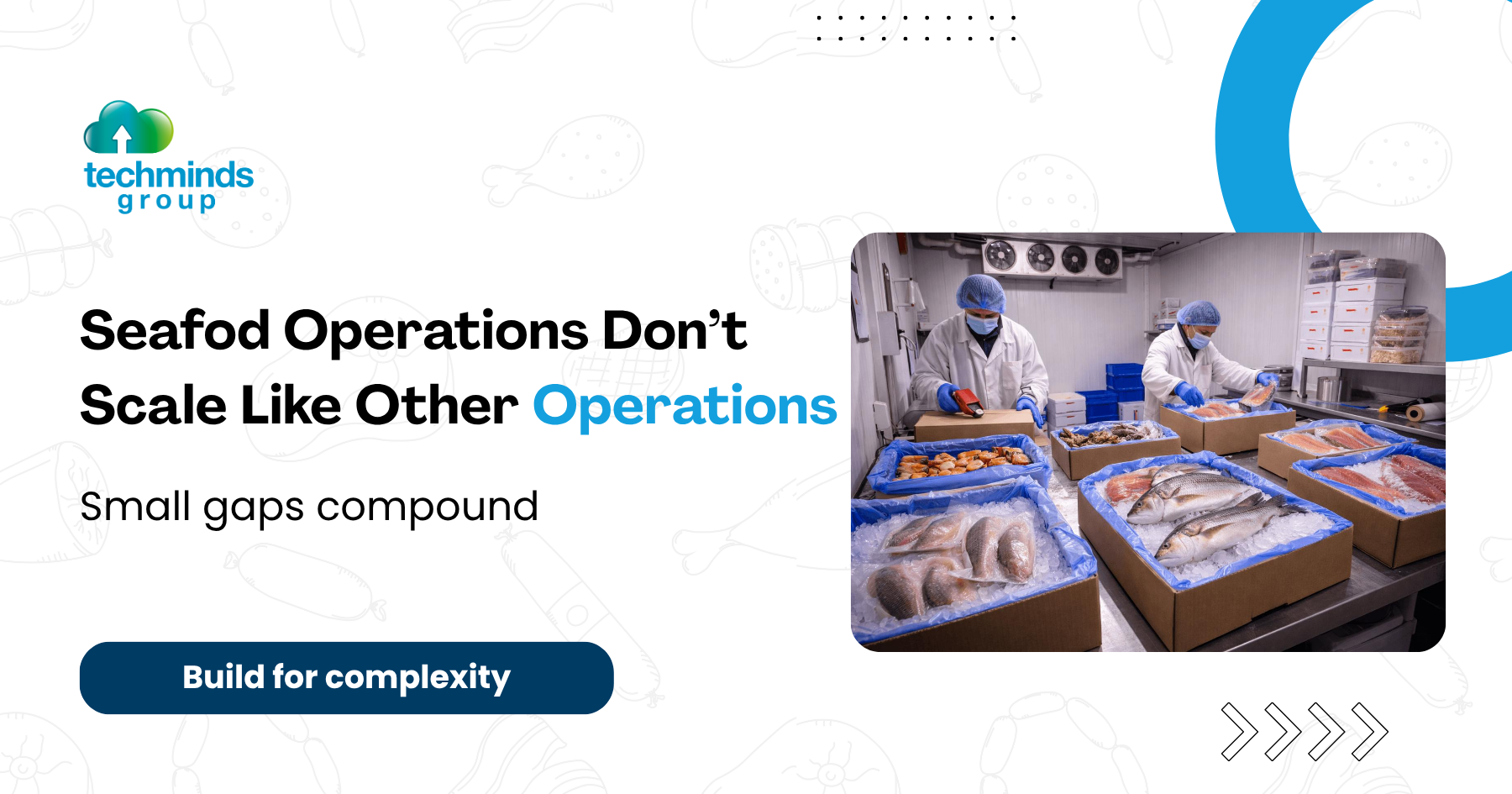
Seafood manufacturing operations have a consistent set of operational gaps that appear across companies of different sizes, different product categories, and different market segments. These gaps are not the result of poor management — they are structural consequences of the operational complexity inherent to seafood processing, applied against systems and processes that were not designed for that complexity.
This article identifies the most common operational gaps in seafood manufacturing, explains why they compound as operations scale, and describes the structural changes that address them.
Gap 1 — Receiving Traceability Disconnection
The most significant and common operational gap in seafood manufacturing begins at receiving. Product arrives from multiple vessels, fisheries, or suppliers — often with varying documentation quality. The receiving process captures what was received, but frequently fails to capture the full traceability data required to support downstream compliance needs.
Specifically: vessel origin, harvest date, fishing zone, and species-level documentation are often recorded on paper, in a separate database, or not at all. The lot number assigned at receiving connects to a quantity and a date — but not to the full chain of custody information that FSMA Section 204 and retail buyer requirements demand.
The gap compounds because: every subsequent production run that uses product from an inadequately documented receiving lot inherits the traceability gap. By the time the finished product reaches the customer, the trace from finished goods back to source documentation may be reconstructable with effort — or may be impossible.
Gap 2 — Multi-Species Inventory Segregation
Seafood operations that handle multiple species face a specific challenge: maintaining physical and system segregation between species, particularly for allergen management and regulatory classification purposes. When inventory management lacks species-level granularity, or when physical storage segregation is not systematically tracked, the risk of species misidentification or allergen cross-contact is structural.
The operational consequence: product labeled as one species may contain traceability records that include a different species. In labeling compliance terms, this is a serious gap. In recall terms, it creates a worst-case scenario where the recall scope cannot be precisely defined.
Gap 3 — Processing Yield Tracking Disconnection
In seafood processing, the yield from a production run — the percentage of input weight that becomes sellable finished product — is a critical performance indicator with direct financial implications. Input fish that yields 55% usable product has a very different cost basis than input that yields 65%.
In most seafood operations we assess, yield tracking is either entirely manual or captured in a system that is not connected to financial records. The result: product costing is based on standard yields rather than actual yields, and the financial variance between standard and actual is absorbed into cost of goods without attribution.
For a CFO trying to understand why margins changed between periods, the yield variance is often the answer — but it’s not visible because the yield data doesn’t connect to the financial system.
Gap 4 — Cold Chain Documentation Gaps
Temperature monitoring in seafood storage and transportation is both a food safety requirement and a customer quality requirement. The gap that consistently appears in seafood operations: temperature records exist — from data loggers, from manual records, from carrier documentation — but they are not systematically connected to the lots they cover.
When an auditor or customer asks “what was the temperature history for this specific lot from your facility to the distribution center?”, the answer requires manually assembling records from multiple sources. The records exist; the connection between them and the specific lot does not.
Gap 5 — Supplier Certification Management
Seafood supply chains are complex — multiple vessels, multiple fisheries, multiple processing intermediaries, multiple cold chain operators. Managing the certification status of each supplier and intermediary — food safety certifications, allergen declarations, species verification documentation — is a continuous compliance management activity.
In most seafood operations, this is managed in a combination of spreadsheets, email inboxes, and physical binders. Certifications expire without automated alerts. New requirements from buyers are not systematically propagated to supplier documentation tracking. The result: during audits, supplier certification files are frequently found to be incomplete or out of date.
Why These Gaps Compound
Each of the gaps above is manageable at low volume with manual effort. As volume scales — more product, more suppliers, more customers, more locations — the manual effort required to maintain the workarounds grows faster than the business. At some point, the workaround breaks under its own weight.
The compounding dynamic is particularly acute in seafood because the complexity is multi-dimensional: multiple species, multiple origins, variable weights, short shelf life, and intensive compliance requirements all interact. Manual management of any one dimension becomes exponentially harder when combined with manual management of the others.
The structural solution is not better manual processes. It is an operational architecture where each of these dimensions is tracked systematically as part of normal operational workflow — not as supplementary activity.
Techminds Group works with seafood processors to address operational gaps at the architectural level — through connected ERP systems designed specifically for seafood and protein manufacturing complexity.
A 15-minute assessment at https://techmindsllc.com/erp-for-seafood-processing-and-distribution/ is a practical starting point.