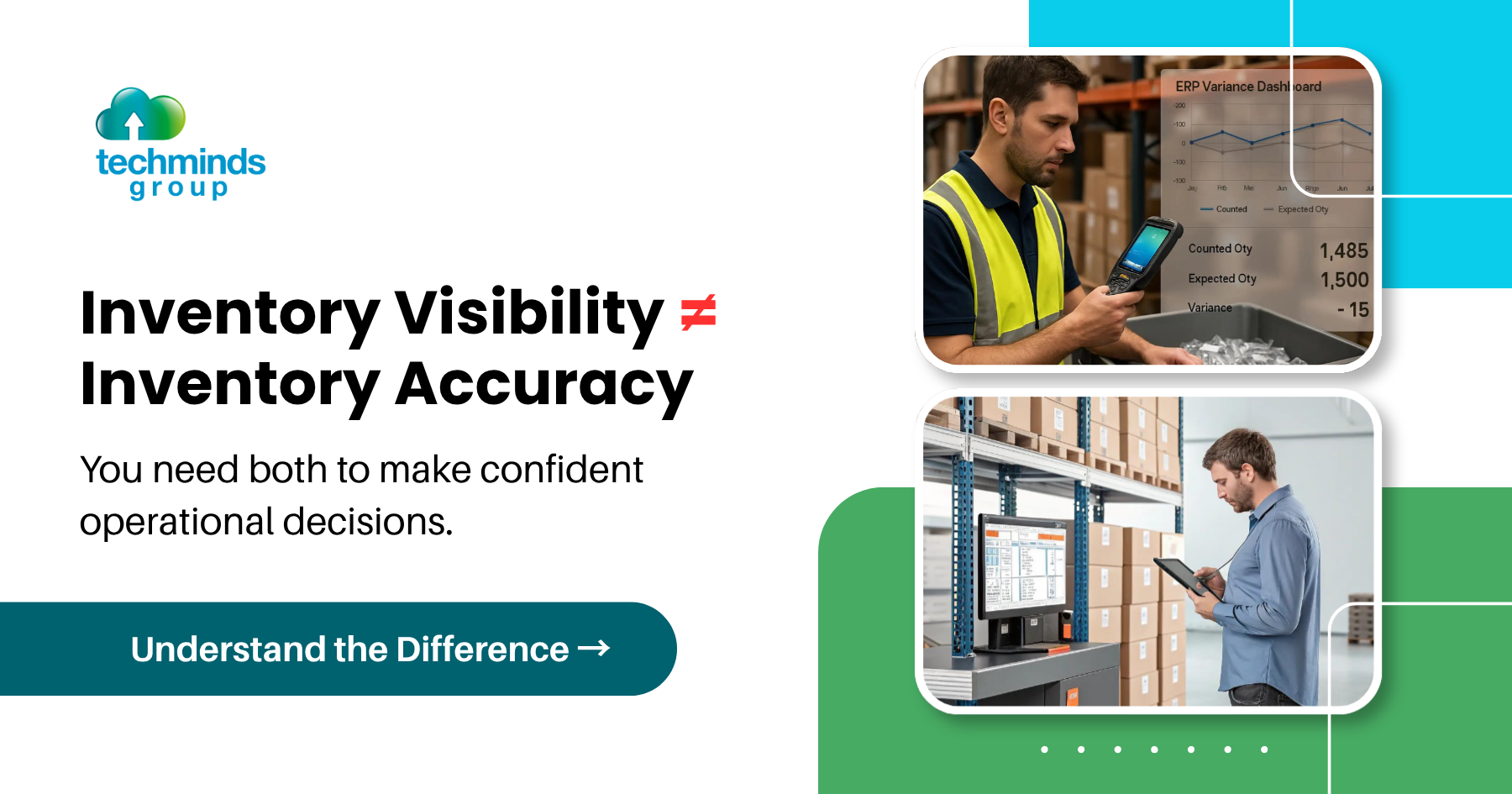
Inventory visibility and inventory accuracy are terms that are often used interchangeably in food manufacturing — but they describe different capabilities, with different operational implications.
Inventory visibility is about access: can the right people see current inventory information when they need it? Inventory accuracy is about correctness: does the information they’re seeing reflect what is actually in the facility?
A food manufacturer can have excellent visibility into inaccurate data. A manufacturer can have accurate data that is visible only to one person, at one terminal, once a day. Both configurations fail to deliver what a protein or seafood manufacturing operation actually needs.
This article distinguishes between the two concepts, explains why both matter, and describes what a food manufacturing operation needs to achieve both simultaneously.
Defining Inventory Visibility
Inventory visibility refers to the ability of relevant decision-makers to access current inventory information at the time they need it, in the form they need it, without delay.
In a protein manufacturing context, visibility has several dimensions:
Real-time vs. batch: Is inventory information updated continuously as transactions occur, or is it updated in batches — end of shift, end of day? Real-time visibility means the inventory record reflects the current state of the operation. Batch visibility means it reflects a past state.
Role-based: Can a production planner see what raw materials are available for today’s schedule? Can the CFO see inventory valuation by location? Can the quality manager see which lots are approaching expiration? Visibility is only valuable if the right people can access the information they need for their specific decisions.
Cross-location: In multi-facility or multi-location operations, can users see inventory across all locations — not just the one they’re physically in? Cross-location visibility is particularly important for frozen and cold storage operations where product may be distributed across multiple storage points.
Mobile and on-floor: Can plant floor staff access inventory information at the point of work — during receiving, during production, during picking — or only at a back-office terminal? On-floor visibility enables real-time transaction capture, which is foundational to accuracy.
Defining Inventory Accuracy
Inventory accuracy refers to the degree to which the inventory record in the system matches the physical reality of what exists in the facility at any given moment.
Accuracy has several components specific to food manufacturing:
Quantity accuracy: Does the quantity shown in the system match the physical quantity on hand? In operations where transactions are recorded with delay or where manual counting introduces error, quantity accuracy degrades continuously between physical counts.
Weight accuracy: In catch weight operations, does the weight recorded in the system reflect actual measured weight, or is it estimated from standard weights or averages? Weight accuracy is foundational to inventory valuation and catch weight billing.
Location accuracy: Does the system correctly reflect where each lot of inventory is physically located? Location accuracy is particularly important for FEFO management — the system can only enforce FEFO correctly if it knows where each lot is.
Lot accuracy: Is the lot number attribution in the system accurate? Does each unit in inventory have the correct lot number, expiration date, and quality status recorded?
Status accuracy: Does the system correctly reflect the status of inventory — available, on hold, in process, reserved for an order? Inaccurate status information is a common source of production planning and order fulfillment errors.
How Visibility and Accuracy Interact
Visibility without accuracy: When users can access inventory information in real time but the information is systematically inaccurate — because weights are estimated, lot tracking is incomplete, or transaction recording is delayed — visibility enables faster decision-making on bad data. The operational outcome can be worse than no real-time visibility, because the speed of decisions amplifies the impact of the underlying inaccuracy.
Accuracy without visibility: When inventory records are accurate but only accessible to specific users, at specific terminals, with delay — the accuracy is not fully utilized. A production planner who has to wait for a report to understand what materials are available cannot make real-time production decisions that capitalize on accurate inventory data.
The operational goal is both: accurate inventory data, accessible to the right people, at the right time, in the right form. This is the foundation for sound production planning, reliable compliance documentation, and accurate financial reporting.
What Achieving Both Requires in Protein Manufacturing
Achieving simultaneous inventory visibility and accuracy in a protein manufacturing operation requires addressing the operational architecture:
Transaction-level data capture: Every inventory-affecting transaction — receiving, production, picking, shipping, transfers between locations — must be recorded in the system at the time it occurs. This requires mobile-enabled data capture for floor transactions, scale integration for weight capture, and barcode or lot scanning for lot attribution.
Connected system architecture: Inventory data must exist in a single system of record that is accessible to all relevant users. When production data and inventory data and financial data are in the same system, they are inherently consistent — no data transfer step introduces error or delay.
Role-based access and dashboards: Different users need different views of the same inventory data. A CFO needs valuation by location. An ops director needs expiration date visibility across lots. A production planner needs available raw material by lot. Building these views into the system ensures that visibility is actionable, not just informational.
Techminds Group designs and implements connected operational systems for protein and seafood manufacturers that deliver both inventory visibility and accuracy as a unified capability.
A 15-minute assessment at https://techmindsllc.com/catch-weight-management-for-protein-and-seafood-manufacturing/ is a practical first step toward understanding where the gaps in your current setup exist.