
Food Traceability and Recall Readiness for Protein Manufacturers
Spreadsheet-based traceability and manual lot tracking processes cannot produce what FSMA Section 204 requires: electronically complete, forward-and-backward lot trace records within 24 hours of an FDA request. And they cannot meet what major retail buyers increasingly require: system-generated documentation, GFSI certification, and sub-two-hour trace response as conditions of supplier qualification. Techminds builds traceability into the operational system — so recall readiness is a tested, verified capability, not an assumption dependent on tribal knowledge about which file to open.
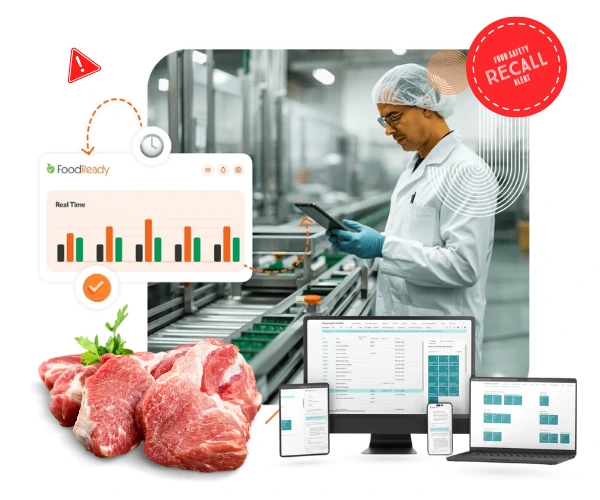
The Gap Between Lot Tracking and Recall Readiness
Spreadsheet-Based Traceability Is Dangerous at Scale
Spreadsheet-based traceability depends on consistent manual entry, naming conventions, and the availability of whoever maintains the file. As volume grows, the manual discipline required to keep lot records complete and accurate degrades. The gap between what the spreadsheet shows and what actually happened widens invisibly — until a recall or audit makes it visible and expensive.
Forward Trace Speed Determines the Recall Outcome
When a recall event is triggered, the critical question is: how quickly can you identify every customer who received product from a specific raw material lot? In a manual process, this takes hours. FSMA expects 24 hours. Major retail buyers expect under two hours. The difference between a managed recall and a brand crisis is measured in this response time.
Multi-Input Lot Tracking Is Where Gaps Appear
When a production run uses material from multiple source lots — common in protein processing — the backward trace must identify all of them. Manual traceability typically tracks only the primary source lot. In a recall, those untracked contributing lots become hidden liability.
Tribal Knowledge Dependency Breaks in a Recall
When the lot tracking process depends on one person knowing how the system works, where records are stored, and how to execute the trace — that person’s availability determines recall response capability. Recall events do not wait for key personnel to be reachable.
Retail Buyer Requirements Now Exceed Regulatory Minimums
FSMA Section 204 compliance is the floor. Major grocery chains and foodservice distributors require system-generated (not manual) lot trace documentation, GFSI certification, and sub-two-hour trace response as conditions of supplier qualification. Traceability has become a sales requirement, not just a regulatory one.
Untested Traceability Is Unverified Capability
Most operations assume their traceability is adequate. Very few have run a recall simulation — a complete forward-and-backward trace on a historical lot — to verify that the result is complete, accurate, and producible within the required timeframe. Assumption is not capability.
What Recall-Ready Traceability Requires
1
Automated Lot Creation at Receiving
Lot numbers created by the system at receiving — tied to supplier, species, harvest date, and receiving documentation. No manual assignment. No end-of-shift entry.
2
Multi-Input Lot Linkage
Production runs automatically record all contributing source lots and link them to output lots. Multi-input lot tracking built into every production transaction — not a separate documentation step.
3
Integrated Outbound Records
Every shipment records which finished goods lots went to which customer. Forward trace records created at the point of shipment — not assembled after the fact.
4
Recall Simulation — Anytime
Run a complete forward-and-backward trace on any historical lot to verify capability. Results in seconds. Any authorized staff member executes it — no tribal knowledge required.
FSMA Section 204 — KDE Requirements for Protein & Seafood Processors
- ✓ Traceability Lot Codes at every Critical Tracking Event
- ✓ Location description at each CTE
- ✓ Records maintained for minimum 2 years
- ✓ Quantity and unit of measure at each CTE
- ✓ Date of each CTE (receipt, transformation, shipping)
- ✓ Electronic production within 24 hours of FDA request
- ✓ Product description including species (seafood)
- ✓ Harvest location / vessel (seafood) where applicable
→ Meat Processing ERP
→ Seafood Manufacturing ERP
→ Food Safety & Compliance
→ Operational Visibility Hub
When did you last run a recall simulation to verify your traceability capability?
If the answer is “never” or “we’re not sure how,” that’s the starting point for the conversation.


