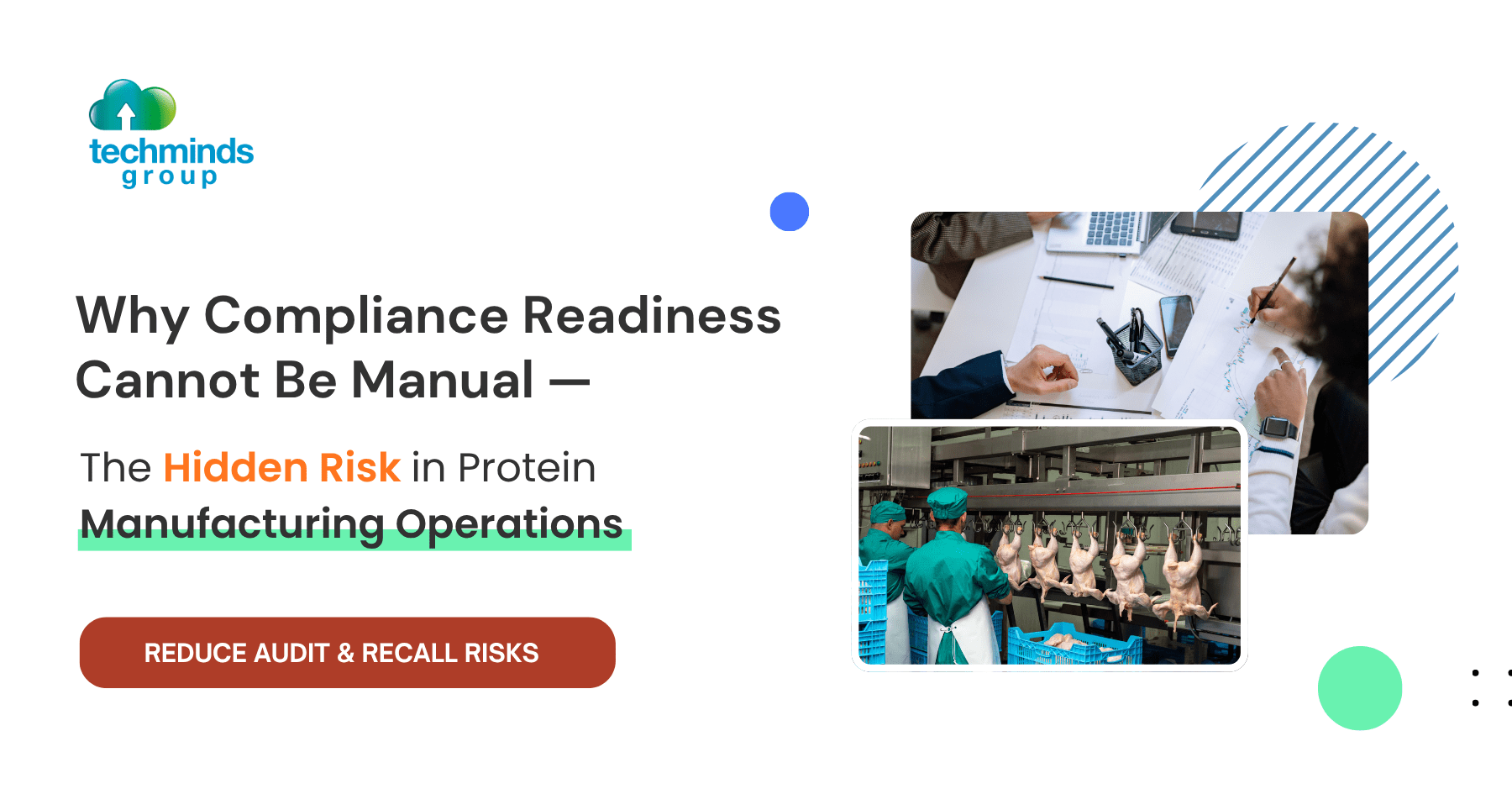
Manual compliance management in protein manufacturing — spreadsheets, paper logs, email trails, shared drives with certificates — works until it doesn’t. The problem is that “until it doesn’t” often arrives at the worst possible moment: during an unannounced USDA inspection, when a major retail buyer sends a compliance questionnaire, or when a customer raises a food safety concern.
This article explains why manual compliance processes create structural risk in protein and seafood manufacturing operations, what compliance readiness actually requires at an operational level, and what the cost of a compliance gap looks like in practice.
What ‘Compliance Ready’ Actually Means
Compliance readiness in protein manufacturing is not a checkbox. It’s an operational capability — the ability to produce accurate, complete, and current compliance documentation on demand, with no advance notice.
In practice, this means:
- USDA and FDA inspection documentation — sanitation records, temperature logs, HACCP records — accessible immediately and current
- Lot traceability records that connect raw material suppliers through production through customer delivery
- Vendor quality certifications and grower certificates tracked with expiration alerts — not discovered to be expired during an audit
- Allergen control documentation current and connected to production records
- GFSI audit preparation that doesn’t require a week of manual document assembly
The standard is not “we have these records somewhere.” The standard is “we can produce these records accurately and completely within the hour.”
The Five Most Common Manual Compliance Gaps
Through implementations with protein and seafood manufacturers, the compliance gaps we encounter most consistently are:
1. Vendor certificate expiration: Quality certificates, grower certifications, and allergen documentation are tracked in a spreadsheet — or not tracked at all — and are periodically discovered to have expired. The discovery usually happens during an audit.
2. Sanitation record disconnection: Sanitation schedules and completion records are maintained on paper or in a separate system, disconnected from production activity. When an auditor asks which sanitation procedures were completed before a specific production run, the answer requires manual cross-referencing.
3. Lot number gaps: Lot numbers are assigned at some steps in the production process but not systematically at others. A request for a complete lot trace produces a report with gaps.
4. HACCP record latency: HACCP monitoring records are completed manually and entered into a system periodically — not in real time. During an inspection, records for recent production runs may not be in the system yet.
5. Single-person knowledge dependency: One person knows where everything is, knows the passwords, knows the filing system. If that person is unavailable during an inspection, the compliance documentation process stalls.
What a Compliance Gap Costs
The cost of a compliance gap in protein manufacturing manifests in several forms:
Regulatory enforcement: An FDA or USDA inspection that identifies missing or inadequate records can result in warning letters, consent decrees, or in severe cases, facility shutdown pending corrective action. The operational and financial cost of a facility interruption at a protein processor is significant.
Retail buyer disqualification: Major grocery chains and foodservice distributors increasingly conduct their own compliance audits as part of supplier qualification. A compliance gap discovered during a buyer audit can result in delayed onboarding, reduced purchase commitments, or supplier removal.
Insurance implications: Product liability insurers have begun incorporating documented compliance capability into underwriting assessments. Demonstrable compliance process gaps can affect coverage terms and premium costs.
Internal cost: The labor cost of managing manual compliance processes scales with business volume. As production complexity increases, the cost of manual compliance management grows proportionally — and the error rate tends to increase.
What Operationally Mature Protein Processors Do Differently
Protein and seafood manufacturers who handle compliance audits without significant stress share a common characteristic: compliance is embedded in their operational workflow, not maintained as a parallel manual process.
Specifically: – Vendor certifications are stored in the same system as purchasing records, with automatic expiration alerts – Sanitation completion is recorded at the point of completion and linked to the subsequent production run – Lot numbers are created automatically when a production or receiving transaction is initiated — not entered manually afterward – HACCP monitoring records are completed in the system at the time of the check — not on paper and transcribed later – Any authorized staff member can access and produce compliance documentation without relying on a single person’s knowledge
When compliance lives in the operational system rather than alongside it, audit readiness is a default state — not a preparation project.
Techminds Group works exclusively with food and beverage manufacturers to build compliance into operational systems — not around them. If your current compliance process would benefit from an independent review, we’re happy to offer a 15-minute assessment at no cost.