
ERP Built for Poultry Processing Operations
Generic ERP systems don’t handle the specific requirements of poultry processing natively. Catch weight variable-weight tracking, cut-by-cut yield analysis, USDA inspection integration, HACCP monitoring connected to production, and allergen control linked to scheduling all require customization in a generic platform — customization that costs more than a purpose-built implementation and delivers inferior functionality. Techminds implements purpose-built poultry processing ERP in 12–20 weeks using a pre-configured food manufacturing foundation where these capabilities are already built in.
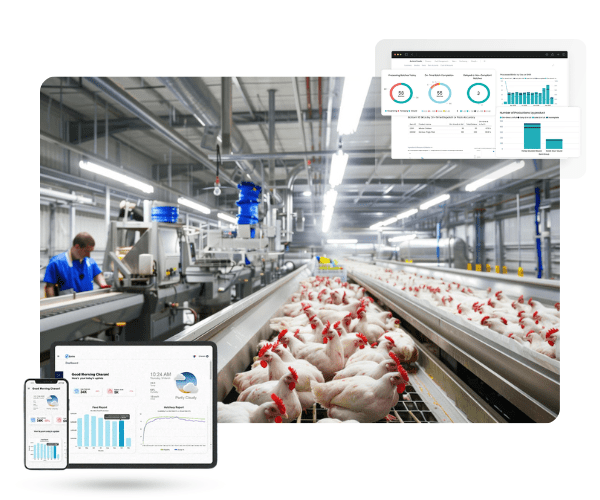
Where Generic ERP Falls Short for Poultry Processing
Cut-by-Cut Yield Tracking
Poultry processing produces multiple cuts from each bird — breast, wing, leg, thigh, back — each with different weight, value, and traceability requirements. Generic ERP doesn’t natively track catch weight at the cut level or calculate yield by cut at the production run level. Product costing is built on standard tables, not actual measured output, creating systematic yield variance that finance cannot attribute.
USDA Inspection Records Disconnected from Production
USDA inspection records, HACCP monitoring, and sanitation documentation must be linked to specific production runs and accessible immediately. When these exist in disconnected systems — paper logs, separate compliance databases, shared drives — audit readiness is a preparation project, not a default state. An unannounced USDA inspection catches operations in the gap between what was done and what can be demonstrated.
Allergen Pre-Requisite Enforcement
Value-added poultry products require allergen control connected to production scheduling, cleaning procedures, and labeling. In disconnected systems, allergen conflicts are managed by procedure — which has gaps under production pressure. Pre-requisite enforcement at the system level — requiring allergen-specific cleaning documented as complete before the next run is authorized — cannot be applied without a connected operational system.
Scale Integration at Line Speed
Poultry production lines move at high speed. Weight data must be captured from scale integration directly into the system — not entered manually at end of shift. Manual catch weight entry at line speed introduces the same billing discrepancy and inventory valuation errors that manual catch weight creates in any protein operation, compounded by poultry processing volume.
FEFO Across Fresh and Frozen
Poultry operations running fresh and frozen product simultaneously require FEFO enforcement across multiple product types, lot dates, and storage locations. Manual FEFO management at poultry processing volumes is reliably unreliable. System-enforced FEFO is an operational necessity — not a preference.
GFSI Certification With Disconnected Compliance
GFSI certification — SQF, BRC, or FSSC 22000 — is increasingly required by major retail and foodservice buyers. Manual compliance processes and disconnected documentation systems make GFSI certification harder to achieve and more expensive to maintain. Purpose-built systems generate GFSI-aligned documentation as a standard output of normal operations.
Implementation Without Disrupting Production — 12–20 Weeks
1
Pre-Configured Foundation
Start from a purpose-built food manufacturing baseline — catch weight, FEFO, lot traceability, HACCP, and allergen management already built in. Configuration to your operation, not custom development from scratch.
2
Operational Assessment
Identify the highest-risk disconnected system gaps — catch weight tracking, allergen control, or compliance documentation — and address those first in the implementation sequence.
3
Parallel Operation
New and existing systems run simultaneously until outputs are validated. Go-live is confirmed accurate before legacy processes are retired — not assumed based on configuration.
4
Phased Go-Live
Functionality introduced by module. For a mid-size poultry processor, typical implementation: 12–20 weeks from kickoff to go-live. Not a multi-year project. Operational capability within a relevant timeframe.
→ Meat Processing ERP
→ Traceability & Recall Readiness
→ Food Safety & Compliance
→ Catch Weight Management
How many generic ERP workarounds is your poultry operation currently maintaining?
A 15-minute assessment identifies what a purpose-built implementation would look like for your specific operation.


