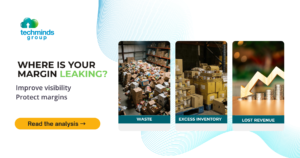
Operational visibility — the ability of leadership to see what is actually happening in production, inventory, compliance, and finance in real time — is the foundational capability that separates high-performing protein manufacturers from those that are perpetually reactive.
When operational visibility is weak, leadership decisions are made on yesterday’s data. Production schedules are set without accurate inventory information. Financial reports are assembled from multiple disconnected systems and are already outdated by the time they’re read. Compliance gaps are discovered during audits rather than in advance.
This article examines the specific visibility gaps that protein and seafood manufacturers face, why they persist, and what operational visibility actually requires to be meaningful.
The Four Most Expensive Visibility Gaps in Protein Manufacturing
Inventory visibility gap: Leadership cannot see accurate, real-time inventory levels across locations. What the system shows and what physically exists in the facility are different numbers — and the difference is discovered at physical count, not in real time.
Production-to-finance visibility gap: Production activity does not automatically update financial records. The cost of goods produced is calculated after the fact, often with significant manual effort, and the resulting product cost figures are estimates rather than precise calculations.
Compliance visibility gap: The compliance posture of the operation — which certifications are current, which sanitation checks have been completed, which lot documentation is complete — is not visible from a single point. Answering the question “are we audit-ready today?” requires checking multiple systems and asking multiple people.
Demand and production visibility gap: Customer orders, production schedules, and inventory positions are managed in separate systems that are not synchronized in real time. When a large order changes — in volume, timing, or specification — the downstream impact on production and inventory is assessed manually, with the latency and error risk that manual assessment implies.
Why Visibility Gaps Persist Even in Well-Managed Operations
The persistence of visibility gaps in well-run protein manufacturing operations is not a failure of management intent. It is a structural consequence of operating with disconnected systems.
When production data lives in one system, inventory data in another, and financial data in a third, real-time visibility requires either a data integration layer (which is technically complex and maintenance-intensive) or a manual process of collecting and assembling data from multiple sources (which introduces latency and error).
Most protein manufacturers have neither a robust integration layer nor a clean manual process. What they have is a series of workarounds — scheduled reports, manual exports, informal communication between departments — that approximate visibility without providing it.
The result is that leadership is always operating with a time lag. The inventory figure cited in a morning meeting reflects yesterday’s receiving, not this morning’s. The production schedule is based on last week’s demand plan, not today’s order changes. The compliance status is based on last month’s audit preparation, not today’s documentation state.
What Real-Time Operational Visibility Requires
Real-time operational visibility in a protein manufacturing operation is not a reporting tool. It is a consequence of operational architecture — specifically, of having production, inventory, compliance, and financial transactions managed in a single connected system.
When this architecture is in place:
- Receiving a shipment of raw material automatically updates inventory, triggers FEFO positioning, and creates the lot record that traceability will follow through production
- A production run automatically consumes the specified raw materials from inventory, records the output lots, links the sanitation and quality records, and updates the cost of goods
- A shipment automatically updates inventory, creates the outbound lot trace records, and generates the financial transaction
- Leadership can see inventory, production status, compliance documentation, and financial position in real time — not because someone assembled a report, but because the operational system is the source of truth
This is the operational architecture that purpose-built food manufacturing ERP systems are designed to deliver.
The Business Impact of Improved Operational Visibility
The business impact of genuine operational visibility in a protein manufacturing context is measurable and consistent:
Faster, better decisions: Leadership makes production, procurement, and customer commitment decisions based on accurate current data — not delayed reports.
Reduced inventory waste: Real-time FEFO visibility prevents expiration-driven write-offs. Knowing what is actually in stock prevents over-purchasing.
Faster compliance response: Audit readiness is a default state — not a preparation project. Compliance documentation is current because it is generated as part of normal operations.
Improved customer relationships: Order changes, delivery issues, and traceability requests are handled quickly and accurately because the data exists and is accessible.
Reduced operational overhead: Manual data collection, reconciliation, and report assembly are eliminated — freeing staff for value-adding work.
Techminds Group builds operational visibility into protein and seafood manufacturing operations — through connected ERP systems designed specifically for food manufacturing complexity.