Almost every operational problem at a growing protein or seafood manufacturer traces back to the same root cause: the business grew faster than its systems did. This is not a failure of leadership or planning. It is one of the most predictable dynamics in food manufacturing.
The systems that worked at $15M in revenue — spreadsheets, legacy software, manual processes, tribal knowledge — begin breaking at $40M. They break faster at $80M. And at $150M, they create operational risk that affects everything from compliance to customer relationships.
This article is about recognizing the inflection point before it creates a crisis.
How Growth Exposes Operational Gaps
Growth in protein manufacturing amplifies operational complexity at a rate most leadership teams underestimate. The math is not linear.
Doubling your order volume does not simply double the workload. It doubles the number of lot numbers being tracked, the number of compliance records being generated, the number of inventory transactions being processed, and the number of manual reconciliation steps in every process that hasn’t been automated. The operational load often grows at two to three times the rate of revenue growth.
The most common pattern: a protein processor wins a significant new account — a regional grocery chain or a national foodservice distributor. The account requires compliance documentation, catch weight invoicing, and lot traceability that the current system manages with difficulty. The team scrambles to meet the requirement. They succeed — but only by adding manual effort, and only barely.
The new account is won. The operational gap is papered over. The underlying system problem is unchanged — and now needs to support higher volume.
The Four Stages of Operational System Failure in Protein Manufacturing
Based on our work with protein and seafood processors across North America, operational system failure follows a consistent four-stage pattern:
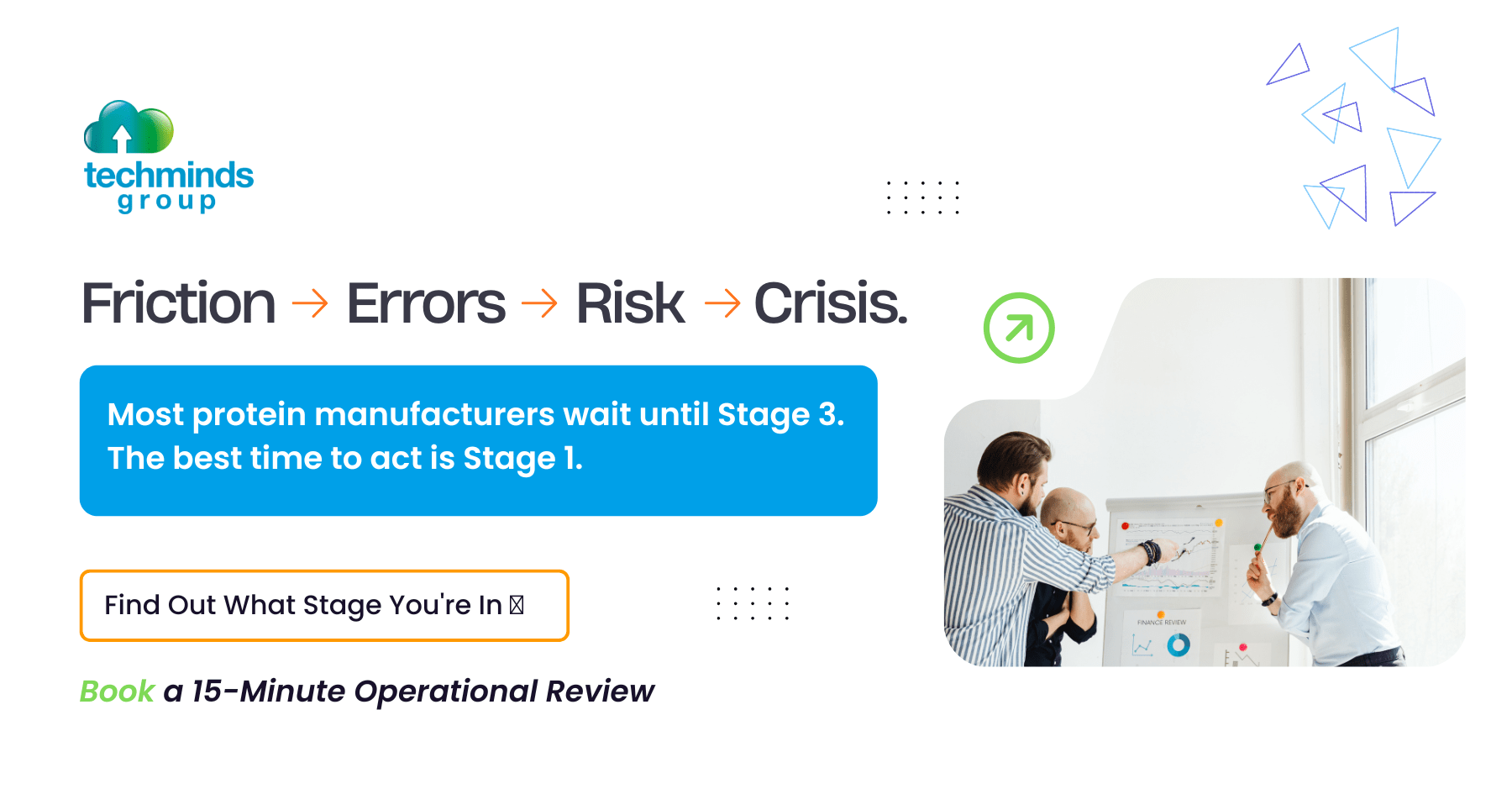
Stage 1 — Friction: The system slows things down, but the team compensates. Extra spreadsheets are created. Workarounds are documented. Staff adds steps to processes that should be automated. Leadership notices that things are taking longer but attributes it to growth.
Stage 2 — Errors: Manual workarounds start generating mistakes. Inventory counts begin diverging from financial records. Catch weight discrepancies appear in billing. Compliance documentation is occasionally incomplete or delayed. Errors are caught and corrected, but the correction process itself adds operational overhead.
Stage 3 — Risk exposure: The errors begin creating external consequences. A retail buyer flags a compliance documentation gap. A USDA inspector notes that records were not immediately available. A customer receives an incorrect invoice for a variable-weight shipment. These events are managed, but they signal that the operational risk has crossed from internal to external.
Stage 4 — Crisis: A recall event, a failed audit, a lost account, or an operational disruption that cannot be absorbed. At this stage, the cost of the system gap is no longer theoretical.
Most leadership teams address the problem at Stage 3. The optimal point is Stage 1 — when friction is noticeable but consequences are still manageable.
What Scaling Protein Operations Actually Need
The operational requirements for a protein or seafood manufacturer to scale without systemic breakdown are well-defined:
Connected production, inventory, and finance: Transactions in one area of the business automatically update all others. Production output creates inventory transactions. Inventory transactions update financial records. No manual data transfer, no reconciliation gap.
Automated compliance documentation: Compliance records are generated as a byproduct of normal operational activity — not as a separate parallel process. Sanitation records, lot documentation, and safety checks are completed in the system at the time they occur.
Scalable traceability: The lot tracking system that handles 500 transactions a week should handle 5,000 without adding staff or manual steps. This requires a database-driven approach — not a spreadsheet.
Catch weight integration: Floor scales feed weight data directly into the ERP system. Catching weight is not a manual data entry step — it is an automatic transaction.
Role-based visibility: Leadership, operations, finance, and compliance can each access the data they need in real time, without requesting it from another department.
When to Address the System Gap
The right time to address operational system gaps is before the growth event that will expose them. The second-best time is during Stage 1, when friction is present but consequences are still internal.
The most expensive time is Stage 3 or Stage 4 — when external consequences have materialized and the urgency premium on the implementation is high.
For most protein processors, the practical trigger for an ERP assessment is one of the following: – A new account is being qualified that requires compliance documentation capability your current system cannot reliably produce – Revenue is approaching the level where reconciliation is consuming more than two full-time equivalent staff days per week – A compliance audit has flagged documentation gaps – An acquisition or facility expansion is planned
If any of these are on your horizon, the system assessment should precede the event — not follow it.
Techminds Group works with protein and seafood manufacturers at the inflection point — before operational system gaps become business consequences. A 15-minute operational assessment is a practical starting point.
Visit https://techmindsllc.com/erp-built-for-meat-processing-operations/.